
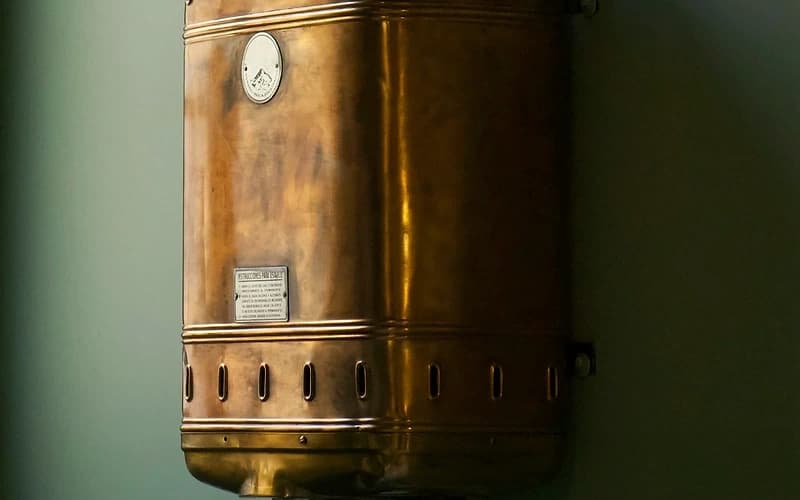
Find out how old yours is, right now
The manufacture date is on the rating label, either printed outright or encoded in the serial number (most brands lead with the year and month, or a letter for the month and digits for the year, the brand’s website decodes it). Subtract from today and you know where you stand in the 8-to-12-year window.
The failure that ends a tank heater’s life is corrosion: the tank rusts from the inside until it weeps at a seam or the base. That failure isn’t repairable, and it rarely announces itself politely, which is why the location of your heater matters as much as its age.
What actually extends the life
Three habits move the needle. Flush the tank yearly to remove sediment, sediment insulates the bottom of the tank, makes gas heaters pop and rumble, and accelerates wear. Check the anode rod every few years, it’s a sacrificial part designed to corrode instead of your tank, and replacing a spent one is the single best life-extender there is. And control pressure: a closed system without a working expansion tank stresses the tank with every heat cycle.
One caution: if a heater is very old and has never been flushed, ask a plumber before disturbing it, loosening a decade of hardened sediment can clog the drain valve or reveal leaks.
When to replace proactively
Replacement stops being pessimism and starts being strategy when these line up.
It’s past year 10
You’re on borrowed time. Nothing may happen this year, but you’re now choosing between a planned swap and an emergency one.
It lives above finished space
An attic or second-floor heater fails downward, through ceilings and walls. Proactive replacement is almost always cheaper than that.
It’s showing the signs
Rusty hot water, popping noises, moisture at the base, or repeated repairs, each one is the tank negotiating its exit.
“Nobody regrets replacing a water heater one year early. Plenty of people regret replacing one one week late.”
The bottom line
Check the label today. If your heater is young, put flushing and an anode check on the calendar. If it’s past ten, especially overhead, get a replacement quote now, while it’s a decision instead of an emergency.