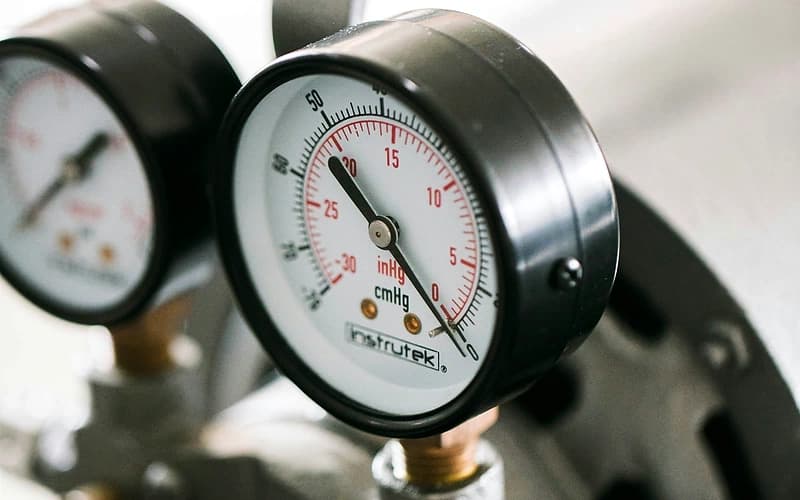
75
Why is my water pressure low?
Quick answerIt could be a clogged aerator, bad regulator, partly closed valve, old pipes, or city supply.
What to do next: Check whether low pressure is at one fixture, hot only, cold only, or the whole house. Clean one faucet aerator and test again. Then verify the main valve is fully open. If the whole house is low, use a hose-bib pressure gauge. If pressure is below normal, call the utility or a plumber depending on whether neighbors are affected.
Read the full guide →76
Why is pressure low only in one faucet?
Quick answerThe aerator or cartridge is usually clogged.
What to do next: Unscrew the aerator, rinse debris, and soak mineral buildup in vinegar if the finish allows. Run the faucet briefly without the aerator to flush debris. If pressure is still low, the cartridge or supply line may be blocked and may need cleaning or replacement.
77
Why is my whole-house pressure too high?
Quick answerThe pressure regulator may be failing or missing.
What to do next: Buy a simple hose-bib pressure gauge and test at an outdoor faucet or laundry connection. Test with no water running. If it is over 80 psi, install or adjust a pressure reducing valve. High pressure shortens the life of toilets, water heaters, faucets, ice maker lines, and washing machine hoses.
78
What water pressure should a house have?
Quick answerMost homes do well around 50 to 70 psi.
What to do next: Use a pressure gauge rather than guessing by feel. If pressure is under 40 psi, investigate restrictions or supply issues. If it is over 80 psi, correct it. Pressure that swings widely can point to regulator or thermal expansion problems.
79
Why does pressure change when someone flushes?
Quick answerThe plumbing may be undersized, restricted, or missing pressure-balancing protection.
What to do next: If the shower gets hot or cold when toilets flush, make sure the shower valve is pressure-balanced or thermostatic. Old galvanized piping can make this worse because it restricts flow. A plumber can check pipe sizing, pressure, and valve type.
80
Why does my shower have weak pressure?
Quick answerThe showerhead, cartridge, valve, or house pressure may be the issue.
What to do next: Remove the showerhead and test flow from the shower arm into a bucket. If flow is strong, clean or replace the showerhead. If flow is weak with the head removed, the cartridge or valve may be clogged. If every fixture is weak, check whole-house pressure.
81
Can hard water reduce pressure?
Quick answerYes, mineral scale can restrict fixtures, valves, and pipes.
What to do next: Check aerators and showerheads for white crust. Use hardness test strips from a hardware store, or send a sample to a local lab if you want exact numbers. If hardness is high and scale is everywhere, a water softener may protect fixtures and water heaters.
82
Why do pipes bang when water shuts off?
Quick answerThat is water hammer from fast-moving water stopping suddenly.
What to do next: Check house pressure first, because high pressure makes hammer worse. Washing machines, dishwashers, and quick-close faucets often need hammer arrestors. Secure loose pipes if accessible. Repeated banging can stress joints, so do not ignore it.
83
What is a pressure regulator?
Quick answerIt reduces incoming city pressure to a safe house pressure.
What to do next: It is usually near the main shutoff, meter, or where water enters the house. If pressure is too high, too low, or creeps upward overnight, the regulator may be failing. A plumber can replace it and set it with a gauge.
84
Can I increase my water pressure myself?
Quick answerMaybe, but measure it first.
What to do next: Put a pressure gauge on a hose bib. If pressure is low and you have a regulator, it may have an adjustment screw. Small adjustments are okay if you know what you are doing, but keep it under 80 psi. If pressure does not respond, the regulator, valve, or piping may be the real issue.
85
Why does water pressure drop at busy times of day?
Quick answerCity supply demand or shared building piping may be the cause.
What to do next: Test pressure at morning, midday, and evening with a gauge. Ask neighbors whether they see the same thing. If they do, call the water utility. If only your house drops, look for a regulator, main valve, softener, filter, or pipe restriction.
86
Why is only my hot water pressure low?
Quick answerThe water heater, hot-side valve, mixing valve, or hot piping may be restricted.
What to do next: Check whether all hot fixtures are weak or only one. If all hot fixtures are weak, make sure the cold inlet valve at the water heater is fully open. Sediment, heat trap nipples, old galvanized hot lines, or a failing mixing valve can restrict flow. A plumber can isolate the hot system.
87
Why does my well water pressure pulse?
Quick answerThe pressure tank, switch, or pump may be cycling incorrectly.
What to do next: Watch the pressure gauge near the tank while water runs. Rapid on-off cycling can damage the pump. The tank air charge may be wrong or the bladder may be failed. Call a well professional or plumber familiar with wells.
88
How do I test my water pressure?
Quick answerUse a hose-bib pressure gauge.
What to do next: Buy a gauge from a hardware store, screw it onto an outdoor faucet or laundry faucet, and turn the water on fully with all fixtures off. Note the static pressure. A gauge with a lazy hand can show pressure spikes overnight. Normal is often 50 to 70 psi, and over 80 psi needs attention.
89
Why does my regulator make noise?
Quick answerIt may be worn, undersized, clogged, or reacting to high flow.
What to do next: Check whether the noise happens only while water runs or also at rest. Test pressure before and after running fixtures if possible. If pressure is unstable or the regulator is old, replacement is usually better than trying to tune it endlessly.
90
Can thermal expansion raise water pressure?
Quick answerYes, heated water expands and needs somewhere to go.
What to do next: Put a pressure gauge with a peak indicator on a hose bib and leave it overnight after hot water use. If pressure spikes high, you may need an expansion tank or the existing one may be failed. This is especially common when a pressure reducing valve or check valve creates a closed system.